
I Finally Had My Second Height Lengthening Surgery!
The full story, six years on.
From 160 cm to 172 cm: the pain, the mistakes, the elevator-shoe trap, a day-by-day diary — and an honest answer to the only question that matters: was it worth it?
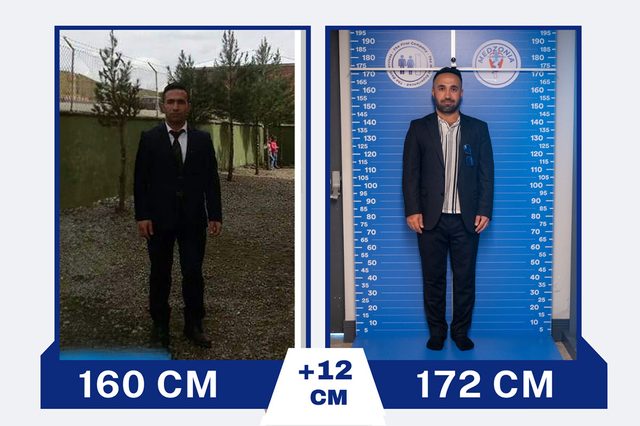
Holyfix method · +6 cm
Combined LON method · +6 cm
Yahoo tell the story
and a team of over 20
I first read that line lying in a hospital bed with a fixator on my leg, and it has stayed with me ever since. If you want to change, you have to accept that you are both the marble and the sculptor — and that the hammer hurts.
My name is İbrahim Alğan. I stopped growing at 160 cm. Today I am 172 cm. Between those two numbers lie two limb lengthening surgeries, one long and difficult recovery, one much better one, an infection, a great deal of stretching, and the decision that changed my life in every sense: I left my job as a school counsellor and founded Wanna Be Taller, Turkey's first company dedicated to limb lengthening patients.
I am writing this as a patient, not as a founder. I began it on the 34th day of my second surgery, lying in bed with a device in my leg. I have come back to it over the years — after the fixator came off, after Business Insider told my story to the world, and now, six years later. If you are thinking about this surgery, this is the article I wish I could have read before my first one.
Why I chose limb lengthening surgery
Here is the odd part: my university degree is in psychological counselling. My job was to help teenagers solve their problems — and I could not solve my own. I watched my classmates shoot past me at fifteen. I felt it again at twenty-three, when I took up my first official post and stood next to my colleagues. The jokes about my height came at least once a week. I laughed along — I was often the one telling them — but inside I froze every time.
Being short is one of the last things people still feel free to mock. It shapes how seriously you are taken at work, how you feel walking into a room, how a relationship starts — or doesn't. I once told a journalist that when you are short, you start every game 1–0 down. That is exactly how it felt.
I tried everything the internet promised — supplements, stretching routines, "grow taller" programmes. I could write a book about the absurd things I tried. None of them added a millimetre. By twenty-four I knew there was only one real option.
My first limb lengthening surgery (2015): 15 months with a fixator
I was terrified of a simple injection. And yet I signed up to have my femurs cut and twelve pins driven through my thighs. Cosmetic limb lengthening was still new in Turkey in 2015; there were very few patients to talk to and very little honest information. Any sensible person would have stepped back. I dived in like a man in love.
The method was Holyfix — a more compact, modern version of the classic Ilizarov frame, but still an external device fixed to the bone through the skin. I told no one. When people noticed I was walking differently, I said I had a bone deformity that needed correcting.
Those days were hard, and they were long. I walked like a penguin. I could not sleep on my side. I needed someone with me almost constantly. Femur lengthening is more painful and far more limiting than tibia lengthening — anyone who has done it will know what I mean. After the fifth month my bones simply decided not to consolidate, so what should have been a year became 15 months and 12 days with the device on.
The result: 6 cm. Fifteen months for six centimetres does not sound like a good deal. But the day the device came off and someone said, "Did you get taller? You look different," I stood in the sun with my arms wide open and felt something I had never felt before. I never regretted it. Not once.
Elevator shoes and the 170 cm "safe zone": why I went back for a second surgery
After the first surgery my obsession dropped from a 10 out of 10 to maybe a 3 or 4. That should have been the end of the story. It wasn't, and the reason deserves a warning of its own.
I had worn elevator shoes — hidden-heel shoes — for years. Before the surgery I felt short even in them. After the surgery I finally felt normal in them. And that was the problem: once you have lived at your "shoe height", your brain adopts it as your real height, and every time you take the shoes off you feel the loss all over again. I had gained 6 cm of bone and given half of it back to a pair of shoes.
There was a strange upside, too. With the surgery behind me and the shoes on my feet, I could finally stand in front of my students and talk about realistic goals without my voice shaking — that it is not the smartest plan to dream of the NBA when you are the shortest boy in the class. I was teaching them what I had needed to hear at fifteen.
I also had a number in my head. For a man, I believed, 170-plus is the safe zone — the point where height stops being a topic. I was just under it. Five years after my first surgery, I decided to close that gap for good.

My second limb lengthening surgery (2020): the LON method
This time I had two things I did not have in 2015: experience, and a team. By then I had founded Wanna Be Taller, watched more than ten surgeons work, and followed hundreds of patients from their first consultation to their last physiotherapy session. I knew exactly what I was walking into — and I chose the combined (LON) method: an internal nail plus an external fixator, worn for a fraction of the time I had spent with the Holyfix.
The difference was night and day. The device was smaller, the period with it was shorter, and — most importantly — I did everything right that I had done wrong the first time: wound dressing every two to three days without exception, stretching every single day, walking even when I did not want to.
The wound care deserves its own line, because it is the thing patients neglect most. In my first days in hospital, the doctor's assistant showed me exactly how to clean and dress the pin sites, and we filmed it so I could repeat it correctly at home. Any discharge, and I clean it with antiseptic and re-dress the area — at least every two to three days, more often if needed. If you have an external fixator, or will have one, this is not optional. "I should have dressed it every hour" is a sentence you only say once you already have an infection.
Limb lengthening diary: days 34 to 41
I kept a diary during the lengthening phase. I have tidied it, but I have not softened it — this is what those days actually feel like.
Five years since the first surgery, 34 days since the second. I have just passed the 3 cm mark. X-ray today; the doctor's assistant will check the gap.
A new morning. Before writing, I did my Achilles stretch and then my 0.25 mm turn. I become a taller person every eight hours — I am growing faster than a teenager. I would love to say I enjoy it, but honesty first: the muscle tension has arrived early. I expected it at 4–5 cm; it caught me at 3. My heels, especially the left, are starting to lift when I walk.
The lesson is already clear: if you want more than 3–4 cm, your flexibility before surgery decides how your lengthening goes. Your Achilles tendons above all. If I had stretched properly beforehand, I would have slept better these last four nights.
Yesterday was the worst day so far. I lay there thinking what every patient thinks: "The doctors don't feel this. It's my leg with the screws in it, not theirs." Then I realised my pain was more stubborn than I was, and that I was only cheating myself. So I put music on, did my stretches, got up and walked — first with the walker, then with crutches. Fifteen minutes later the pain had eased. You either curse the darkness or you walk towards the light. Yesterday I walked.
I have also decided to lengthen three times a day instead of four. I will lose a little time, but it is the healthier choice, and it leaves more room for exercise.
One more thing I have noticed: I move more when I share. When I film my exercises or my walking for the videos, I stretch further and walk faster than I do alone — on the days I don't film, I barely manage half. Music helps in the same way; I walk to it and forget to count the minutes. Even just watching exercise videos instead of a film gets me off the bed. Sharing gives you more than it takes.

Writing late at night — every limb lengthening patient knows what an uninterrupted night's sleep is worth. With tibia lengthening the tension pain rises sharply after 3–4 cm, and it takes your sleep with it. I must be close to 4 cm now.
When I hit 4 cm in my first surgery, I was as excited as a child. This time the excitement is calmer, because the obsession is gone. I just want a healthy 5–6 cm and the device off. Every day brings that closer.
If you are wondering how the days pass: I work from my home office, less efficiently than usual. I have finished one book and started the second. I read the articles that interest me on the sites I follow. I have started watching foreign films in English — partly to improve my English, partly to make the evenings shorter. Sometimes I play strategy games. And there is this diary.
I don't want to keep the diary too long; I would rather write properly once I am back on my feet. Although — if I wrote every day, it might turn into a book. I have been meaning to write one, with a psychological analysis of everything I went through. I think laziness is winning for now.
I walk more than ever, because the tension in my left leg increases daily and my heel refuses to touch the floor until I have walked for fifteen or twenty minutes. Four or five times a day, I do my share. Today I also plan to film a new exercise video — writing a plan down and sharing it is the best way I know to actually do it. I will try a few new movements; the basics are in my earlier videos. Please do not copy them without asking a physiotherapist or your doctor first.
And on the number: once I reach 5 cm, I will only continue to whatever limit my doctor sets after checking my muscles, nerves and bone union. Six, maybe six and a half, will be enough. I have watched too many patients chase one more centimetre and lose six months for it.
Seven lessons for anyone planning leg lengthening surgery
Start a proper flexibility programme weeks before surgery — hamstrings, calves and above all the Achilles tendon. It is the single biggest predictor of how comfortable your lengthening will be.
I had a superb one during my first surgery and still repeat what she taught me. Even online support makes a measurable difference. Knowing what to do is not the same as doing it.
Because it does. Every two to three days, and any time there is discharge. My first-surgery infection cost me months.
I have seen patients demand "just 1–2 cm more" because they paid for it. Some spent six months relearning to walk instead of one. Nobody swaps healthy legs for long legs they cannot use.
Especially when it hurts. Fifteen minutes of walking did more for my pain than any amount of lying still.
When I filmed my exercise videos, I trained harder and walked faster. Accountability is a painkiller.
Decide what height you want to be, not what height you want to wear.
It has been a long time. I haven't written here in a while — and I know my story has been read by a great many people, because the messages keep coming, asking how I am now. I am writing this completely past everything: the surgeries, the pain, the complications.
I think I was one of the very first people in Turkey to have this surgery for cosmetic reasons, back in 2015. In those days, finding someone who had actually been through it and could answer your questions was almost impossible. Today you can meet a patient on almost every platform — and that has created a new problem. It has become genuinely hard to tell accurate information from advertising, and honest criticism from slander. For someone reading and researching, it is difficult to make the right decision, because in the end you decide on what you read, what you see, and your gut.
I will leave that controversial subject there. What I can say is this: I founded the first company in Turkey working in this field. I have seen hundreds of patients. I built a team that works hard, gives accurate information and — most importantly — can empathise, because many of us have been where you are. Wherever in the world you decide to have your surgery, my advice is the same: never stop learning, never stop asking, and hold on to life.
Was limb lengthening surgery worth it?
I get asked this more than anything else, so let me answer it plainly. It was not an easy journey. Two surgeries, an infection, a fixator for 15 months, sleepless nights, pain I would not wish on anyone.
I know what an inferiority complex does to a life. Mine was not "normal". Everything I endured was so that I could have a normal one: not to be short, not to be the punchline, to be confident in my career, to start a relationship without taking a step back before it even began.
But this is not a story to encourage bravery. If your height is fine and you are simply curious, none of this is worth it. If your height is the biggest problem in your life and has been for years, this surgery can be the light at the end of the tunnel. Only you can tell which of those two people you are — and if you cannot tell, wait.
The story goes global: Business Insider and the press
In January 2023, Business Insider published my story. They wrote that surgery had changed more than my height — it had changed my career and, in my words, my confidence. Within days it had been picked up by MSN, Yahoo and dozens of other outlets, and hundreds of thousands of people had read it.
Before the surgery I was someone who kept away from people and read books to comfort himself. Now hundreds of thousands of people know my story. I do not say that to boast; it comes with a responsibility I take seriously — to give the people who write to me the honest information I never had.

Six years after limb lengthening surgery
I am no longer 1.60. I look at life from 12 cm higher and — as I once wrote in this diary — with thousands of kilometres of lengthened hope.
The small things are the big things. I no longer look like the birthday boy when I wear a suit. When I walk down the street I look at people's eyes, not their shoulders. Buying clothes is no longer a small disappointment. I do not take a step back at the start of anything.
Writing this, I understand why I put it off for so long: it means meeting my old self again. I feel sorry for him, the way you feel sorry for a friend. But I also owe him everything.

Professionally, I resigned from counselling and built Wanna Be Taller into a team of more than twenty coordinators, physiotherapists and nurses speaking eight languages. Since 2015 we have accompanied more than 760 patients from over 60 countries. I never feel like I am working; it feels like talking with friends who are where I once was. My only complaint is that some patients arrive shorter than me and leave taller.
Thinking about your own journey?
Write to me or my team. We will tell you honestly whether this surgery is right for you — and if it isn't, we will tell you that too.
Limb lengthening surgery FAQ: what people ask me most
How tall were you before and after?
160 cm before my first surgery; 172 cm today. The first surgery (femur, Holyfix) added 6 cm; the second (tibia, combined LON method) added another 6 cm.
How much did it cost?
Around $27,000 in total for both surgeries at the time. Current all-inclusive package prices are on the cost page and in the calculator.
Which surgery was harder?
The first, by far. Femur lengthening is more painful and limiting than tibia, the Holyfix frame stayed on for 15 months because my bone consolidated slowly, and I had an infection. The second surgery, with the LON method and proper preparation, was a completely different experience.
Do you regret it?
No. Not the first surgery, not the second. But I only recommend it to people for whom height has been a serious, long-standing problem — not to anyone who is simply curious.
Can I get more than the surgeon recommends?
Please don't. I have watched patients push for an extra 1–2 cm and spend months recovering function that should have taken weeks. Your surgeon's limit is set by your muscles and nerves, not by what you paid.
What should I do before surgery?
Stretch — seriously and daily, especially your Achilles tendons and hamstrings. Learn wound care, and arrange physiotherapy support in advance. Our physiotherapy page explains how we support patients through this.
First published January 2021. Updated October 2022 and August 2026. Written by İbrahim Alğan, founder of Wanna Be Taller. This is a personal account, not medical advice; decisions about surgery should always be made with your surgeon.